

A cracked or sinking concrete patio is usually a ground problem or a construction problem, not a concrete problem. In New Orleans, clay that swells and shrinks, organic soils that settle once drained, heavy rain, and summer heat on fresh concrete account for most of what homeowners see.
Concrete cracks everywhere, but New Orleans gives it more reasons than most places. The soil under many yards moves with the seasons, some of it settles for decades, and the city averages more than 63 inches of rain a year at the airport weather station.
Each of those forces leaves its own kind of mark. Reading the pattern of the cracks tells you a lot about what happened under and inside the slab.
At TurnKey Renovators, we pour concrete patios, walkways and driveways for homes and businesses across the New Orleans area, and patio repair and replacement are part of that work.
If your patio is cracking or tilting and you want a second set of eyes on it, contact us and we will help you work out what is going on.
This guide covers what the ground under New Orleans does to a slab, how water and soil movement crack it, which cracks start on pour day, and how to read the cracks in your own patio.
The short answer is the soil. Federal soil surveys of Orleans Parish show a mix of heavy clays and drained marsh soils, and both move under a slab in ways sandy or rocky ground does not.
The USDA Natural Resources Conservation Service (NRCS) maps the parish’s soils. Outside of open water, the largest map units include Schriever clay (about 17,900 acres), Harahan clay (about 10,400 acres) and Westwego clay (about 3,900 acres), along with marsh mucks.
NRCS measures how much a soil swells and shrinks with a number called linear extensibility percent, or LEP. Its National Soil Survey Handbook rates anything at 9 percent or more as very high shrink-swell potential.
The representative LEP values in the Orleans Parish survey run well past that line. Schriever clay reaches about 19 percent, Westwego clay about 17 percent and Harahan clay about 16 percent in the upper layers NRCS describes.
The handbook is direct about what that means. When shrink-swell is rated moderate to very high, it says, shrinking and swelling can damage buildings, roads and other structures.
The parish also has drained organic soils, such as Allemands muck and a soil series named Kenner muck. These soils formed in old marsh and settle once the water is pumped out, a process NRCS calls subsidence.
The ground itself is also moving on a larger scale. A NASA study of 2009 to 2012 satellite data found sinking of up to 2 inches a year in the Michoud area, with groundwater pumping and dewatering as the main contributors.
A concrete slab is strong when it is pushed on and weak when it is pulled apart. When the ground under it rises in one spot and drops in another, the slab bends, and it cracks where the pull is greatest.
High shrink-swell clay takes on water and expands after rain, then pulls back and cracks open in dry spells. NRCS notes that the greatest shrink-swell potential comes from smectite-type clays, and it lists desiccation cracks and leaning utility poles among the field signs.
A compacted base helps a slab ride over that movement more evenly. Our concrete patio installation page explains how we compact the soil and add a gravel base before any pour.
Organic soils behave differently. NRCS defines subsidence as the drop in surface elevation after wet soils with organic layers are drained, and it says the first, faster stage happens within about 3 years of drainage.
The representative total subsidence the survey lists for drained Kenner muck in Orleans Parish is 130 centimeters, about 51 inches, and 46 centimeters for drained Allemands muck. The handbook adds that total subsidence is rarely reached except where the organic layer is thin or drainage has been in place a long time.
What matters for a patio is the handbook’s warning about different rates. It says utility lines, sidewalks and roads without special foundations may settle at different rates, so a patio slab beside a house on a different foundation can drop while the house does not.
New Orleans Airport averages 63.35 inches of precipitation a year under NOAA’s 1991 to 2020 normals, with about 20 days a year bringing an inch or more. That water has to go somewhere, and a flat patio with no slope sends it under the edges.
The National Ready Mixed Concrete Association (NRMCA) says a slab and its subgrade should be sloped for proper drainage. Our concrete services page notes that cracks wider than a quarter inch can let water seep beneath the slab.
Water collecting on or near the slab can erode the base material and speed up cracking. That is how a patio that cracked a little can start to sink.
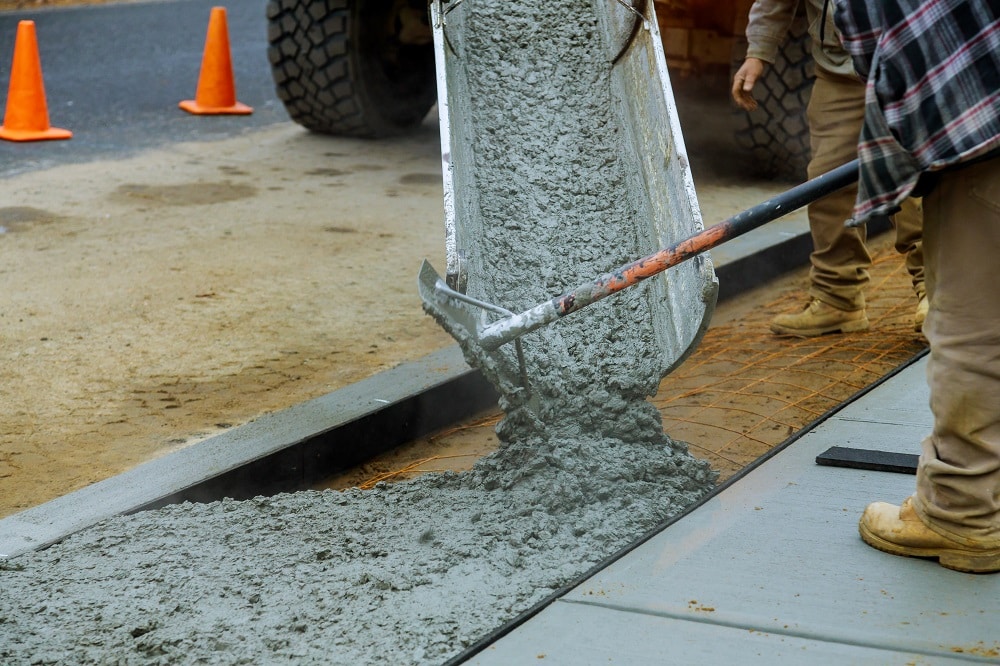 Not every crack comes from the ground. NRMCA says the majority of concrete cracks come from design and construction practices, such as missing joints, poor subgrade preparation, too much water in the mix, improper finishing, fast drying and little or no curing.
The first of those can show up within hours. NRMCA’s guide on plastic shrinkage cracking says these cracks form in the surface of fresh concrete soon after it is placed, when water evaporates from the surface faster than the mix can replace it.
Wind over 5 miles per hour, low relative humidity and high air or concrete temperatures all speed up that drying. NRMCA describes the result as cracks that are usually parallel, roughly 1 to 3 feet apart, shallow, and that rarely reach the slab’s edge.
Summer heat adds its own pressure. NOAA’s normals put the average July high at New Orleans Airport at 91.4 degrees, with about 85 days a year reaching 90 degrees or more. NRMCA advises avoiding the hottest part of the day for placing and finishing concrete.
Humidity gets more blame than it deserves. NRMCA notes that high relative humidity generally tends to reduce the effects of high temperature, so a dry, breezy afternoon can be harder on fresh concrete than a muggy one.
Temperature swings matter too. NRMCA warns that thermal cracking can follow a pour on a hot day followed by a cool night.
Curing decides how the slab holds up for years. NRMCA says curing usually runs 3 to 7 days, and concrete left to dry out can lose as much as 50 percent of its potential strength compared with concrete that is kept moist.
For a broader look at protecting a patio once it is in place, see our guide on how to take care of your concrete surfaces.
The pattern of the cracks is the best clue you have. A few minutes with a tape measure and a level will usually point you toward one of three causes.
Shallow cracks running side by side, a foot or a few feet apart, that stop short of the edges match NRMCA’s description of plastic shrinkage. They formed while the concrete was still fresh.
NRMCA says these cracks are unsightly but rarely weaken the slab. They can, however, let water and chemicals into the surface and become starting points for later cracking.
Joints are planned cracks. NRMCA calls them pre-planned cracks and says joint spacing should be 24 to 36 times the slab’s thickness, which works out to about 10 feet for a typical 4-inch slab, with 15 feet as a recommended maximum.
It also says panels should be square or nearly so, with the length no more than 1.5 times the width, and that a contraction joint should be cut at least a quarter of the slab’s depth. Measure your patio’s panels against those numbers.
If the panels are much larger, or the joints are shallow grooves, the slab chose its own crack lines. NRMCA adds that wire mesh and rebar cannot prevent cracking, though placed correctly they can keep cracks narrower.
A patio poured tight against a house, steps or another slab needs room to move as well. NRMCA recommends isolation joints that separate patios from sidewalks, garage slabs and stairs.
A section that has dropped, tilted toward the house or opened a widening crack points below the surface. NRMCA lists settlement cracks among the common forms, and in New Orleans soil movement and washed-out base material are the usual suspects.
Watch which way the slab tilts. A patio that now drains toward the house sends rain to the foundation instead of away from it, which is a problem worth catching early.
Patios that carry more than furniture deserve the same check. If yours supports an outdoor kitchen or the posts of a retractable pergola, movement under the slab can pull on those features too.
Most cracked patios in New Orleans tell a story of clay that moves, organic soil that settles, water that finds the base, or a pour that dried too fast. Knowing which one you are looking at is the first step to decidin

 Turnkey Renovators