Rust stains running down a stucco wall. A railing that wobbles when you lean on it. Paint flaking off a balcony you have been meaning to deal with for three summers.
In New Orleans, ironwork is part of what makes a house look like it belongs here, and it is also one of the parts of a house that suffers most quietly.
The good news is that old ironwork can usually be saved. The City of New Orleans Historic District Landmarks Commission says plainly in its design guidelines that both wrought iron and cast iron are highly prone to rusting, and it treats regular rust removal and repainting as one of the best ways to protect them.
At TurnKey Renovators, we restore existing balconies and railings, working with traditional wrought iron techniques and cast iron reproductions to match the original.
If your railings or balcony need attention, contact us and we will look at what can be repaired before anything is replaced.
This guide walks through the restoration process in the order it should happen, from permits to the last coat of paint.
According to the HDLC’s guidelines for porches, galleries and balconies, rusting iron can grow 7 to 10 times its original thickness. Where the iron is embedded in a wall or slab, that expansion cracks the surrounding material and affects the building’s structural integrity.
Iron rusts when it is exposed to water and air, and New Orleans supplies plenty of both. Rain, humidity and condensation reach every joint, rivet and scroll of an ornamental railing, and once the paint film is broken, rust spreads underneath it.
The real damage usually happens where you cannot see it, and by the time it shows on the surface it has often been working for years. Rust that forms inside a joint, under a post base or where a bracket enters a wall expands as it grows, pushing pieces apart and cracking the masonry or stucco around them.
The HDLC guidelines describe two separate issues with rusting iron. The first is the expansion itself, which damages whatever the iron is set into. The second is the loss of strength in the iron component, which can turn a decorative railing into a safety problem.
That is why restoration starts with an assessment, not a can of paint. Painting over a structurally weak railing makes it look better without making it safer.
Before any work starts, check whether your property sits inside a local historic district or is a designated landmark. The HDLC guidelines state that properties outside the Vieux Carré that are on the local historic inventory fall under HDLC jurisdiction.
For those properties, a Certificate of Appropriateness is required for exterior work, including work that might be considered ordinary maintenance and repair. The one exception the guidelines name is repainting. They also note that most maintenance and repair applications are reviewed at staff level and completed within 5 business days.
Two HDLC positions are worth knowing before you plan anything. It does not approve adding ornamental iron where it is not documented for that style of building.
It also does not approve removing contributing ornamental metals. Restoration is the expected path.
If the project involves rebuilding part of a balcony or gallery, expect to show your work on paper. The guidelines require dimensioned drawings of all components and details for proposed porches, balconies and galleries. Photos of the existing ironwork, taken before anything is removed, also make it far easier to match replacement pieces later.
If your property is in the French Quarter, it sits outside HDLC jurisdiction and under the Vieux Carré Commission, so check with the city before starting. Outside any historic district, the usual city permits still apply to structural work.
Knowing whether a piece is wrought iron or cast iron changes how it is repaired.
The HDLC guidelines describe wrought iron as hand made by heating, beating and stretching iron into decorative hardware, and common into the early 19th century. Cast iron was formed in foundry molds and became popular in the mid 19th century, which allowed larger and more elaborate pieces such as columns and repeated decorative panels.
In practice, wrought iron tends to show hammer marks and slightly irregular bars, while cast iron shows crisp, repeated patterns. Many New Orleans balconies combine both, along with later steel repairs.
Each material behaves differently. Wrought iron can often be reheated and reshaped.
Cast iron is more brittle, so a cracked casting is usually repaired or replicated, not bent back into shape. That is why identifying the material comes before any repair method is chosen.
Look at the ironwork piece by piece, and pay closest attention to the places where water collects. Take photos as you go, so the condition of each section is on record.
 Post bases and feet. Where a post meets a step, slab or porch floor, water sits and rust builds out of sight. Bulging, flaking or cracked masonry around a base is a warning sign.
Wall connections. Brackets and anchors set into brick or stucco can crack the wall as they rust and expand, which is exactly the problem the HDLC describes.
Joints and fasteners. Loose rivets, failed welds and gaps between pieces let a railing move. Movement under hand pressure is a safety issue, not a cosmetic one.
Thin or holed sections. Rust that has eaten through a bar or left a section paper thin means that piece needs repair or replication.
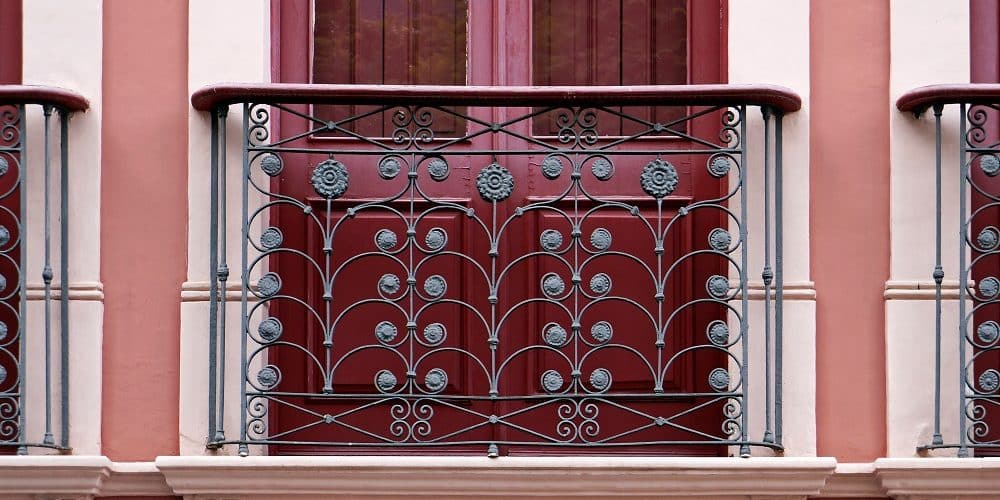
Railing height. Many historic railings were built lower than modern codes expect. The HDLC guidelines show one approach on a historic balcony: a higher secondary safety rail installed behind the cast iron balustrade to meet code requirements. It keeps the original iron in place while making the balcony safer to use, and it is worth discussing before any repair plan is set.
If a railing or balcony moves, sags or has lost sections, keep weight off it until it has been assessed. A balcony that carries people is structural, and its supports matter as much as its decoration. The brackets, outriggers and posts underneath deserve the same close look as the railing on top.
Once the assessment is done, the work begins with the iron that can be kept. That matches the HDLC’s own recommendation to replace only those parts or components that cannot be repaired.
Rust and failing paint come off first, down to sound metal, using a method suited to the piece and its condition. Fine castings and thin decorative elements need a gentler approach than heavy structural members.
Old ironwork often carries many layers of paint, and in older homes some of those layers may contain lead. The US EPA’s Renovation, Repair and Painting rule applies to firms disturbing lead-based paint in homes, child care facilities and kindergartens built before 1978, and requires workers trained in lead-safe work practices. Factor that into how paint removal is handled on an older house.
With the surface clean, broken joints are refastened, cracked sections are repaired, and loose anchors are reset. Where an anchor has cracked the surrounding masonry, the wall around it needs repair as well, or the problem returns.
It also pays to fix the reason water reached the iron in the first place. A gutter that overflows onto a balcony, a porch floor that holds water at the post feet, or a downspout that splashes against a railing will undo a restoration within a few seasons.
Some pieces are too far gone. A missing baluster, a shattered casting or a section rusted through cannot be saved, and has to be replaced.
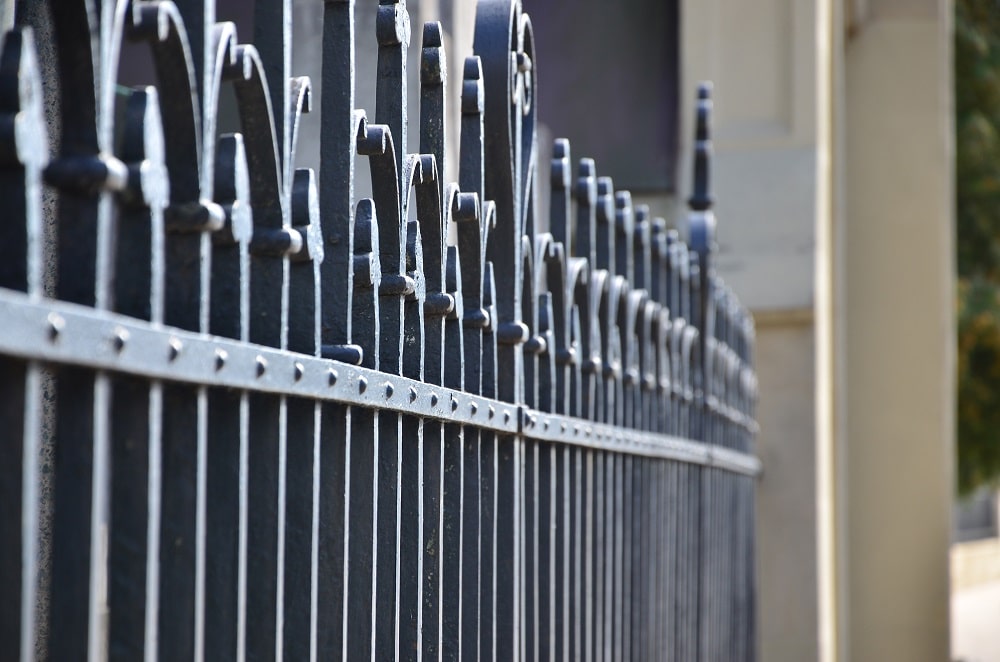 The HDLC recommends custom replication of individual deteriorated components, such as balusters, instead of replacing an entire railing. It also permits replacement with another material when the dimensions, profiles and detailing match the historic component exactly.
For cast iron in particular, where duplication can be very expensive, the guidelines say the HDLC will consider alternate materials, provided they match the appearance, size, profiles, texture and finish of the original.
This is where a careful restorer earns their keep. A new piece that is slightly too thick, or a pattern that does not quite line up, stands out on a balcony that has looked the same for generations.
The usual approach is to take an intact piece from the same railing as the model, so the replacement copies the real profile, not a catalog version of it. Each new piece is then fitted, fastened and finished the same way as the originals around it, so the repair disappears once the whole railing is painted.
Paint is what protects the iron, so the finish is not a cosmetic last step. The HDLC guidelines name regular surface rust removal and repainting with a rust inhibitive paint as one of the best ways to protect ornamental metals.
Prime and paint the restored iron as soon as the surface is clean and dry, before new rust can form. Bare iron left exposed even for a short stretch of humid weather can start to rust again, which undoes the cleaning work. Pay attention to the undersides of rails, the inside of scrolls and the feet of posts, since these are the spots that fail first.
After that, maintenance is what keeps the work from being repeated. A simple yearly routine covers most of it:
Small repairs done every year keep the original iron in service longer and help put off the day a full restoration is needed.
If you are also planning exterior painting for the house, our exterior painting service can be coordinated with the ironwork so both are finished together.
Ironwork restoration works best in the right order. Confirm what approvals you need, identify the material, assess the structure, save what can be saved, replicate only what cannot, then protect it all with a sound paint system.
At TurnKey Renovators, we restore existing iron balconies and iron railings across the New Orleans area, and our railings are built to meet current building codes. You can see the full range of our ironwork services, and if your house needs more than its ironwork, our historic home renovation page covers the wider project.
To talk through your railings or balcony, call us at (504) 527-8711.
If your property is in a local historic district outside the Vieux Carré, or is a designated landmark, the HDLC guidelines say a Certificate of Appropriateness is required for exterior work, including ordinary maintenance and repair, with repainting as the exception. Most maintenance and repair applications are reviewed at staff level within 5 business days. In the French Quarter, check with the Vieux Carré Commission instead.
Often it can be repaired. Cleaning, refastening and repairing sound castings is preferred, and the HDLC recommends replacing only the parts that cannot be repaired. Where a casting is broken or rusted through, a matching replica of that individual piece is usually the better answer than replacing the whole railing.
Wrought iron was hand made by heating and hammering, so it often shows slight irregularities and hammer marks. Cast iron was poured into molds, so it shows crisp, repeated patterns and larger decorative shapes. Many older New Orleans balconies mix both, so it is worth having each section identified before repairs begin.
Painting directly over loose rust traps it under the new paint, where it keeps spreading. The HDLC guidelines describe removing surface rust first and then repainting with a rust inhibitive paint, down to sound metal, with primer before the topcoat. On an older house, keep in mind that old paint layers may contain lead, which changes how the removal should be handled.
It depends on the building and the district. The HDLC guidelines say the commission does not approve adding ornamental wrought or cast iron where it is not documented for that style or type of building, and new galleries and balconies are permitted only in select cases. Check with the HDLC before planning one.


 Turnkey Renovators